A conducting rod slides along two rails in a magnetic field. A current flows through the circuit, and a resistor becomes warm. The magnetic field is essential to the process. Yet the magnetic force does no work on an individual charge. How can both statements be true?
The difficulty comes from using only part of a charge’s motion in the work calculation. A charge in the rod moves with the rod and also drifts relative to it. The magnetic force is perpendicular to the charge’s total velocity in the chosen reference frame, not necessarily to its drift velocity alone.
The moving-rod arrangement
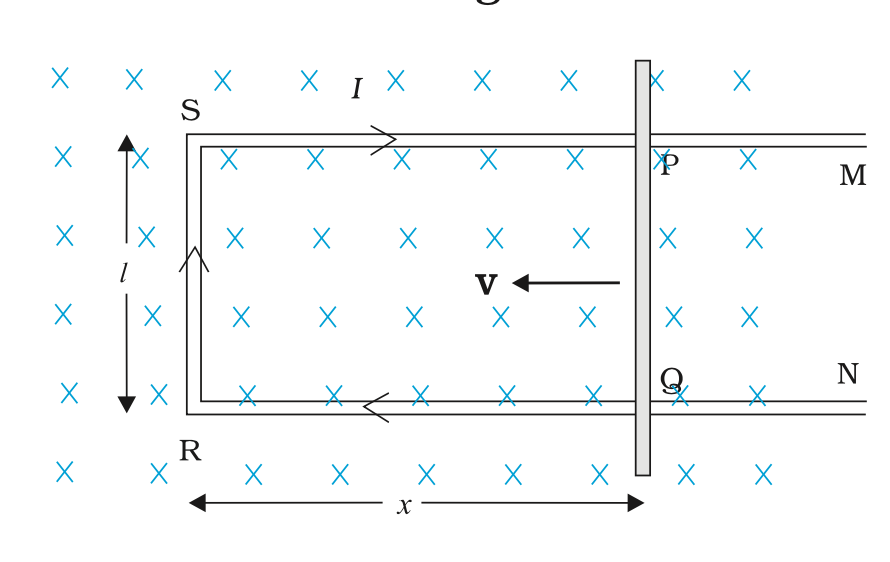
Figure: The circuit diagram labels the rod speed v; this article uses for that speed and reserves for the charge’s total velocity. The crosses indicate a field into the page. The circuit’s resistance is represented by in the text, while R in the drawing labels the lower-left corner.
Consider a vertical conducting rod PQ of length , with P at the top and Q at the bottom. Its ends maintain contact with two stationary horizontal rails, which are joined through a resistor to form a closed circuit. An external agent pulls the rod to the left at constant speed . A uniform magnetic field of magnitude points into the page.
Take the positive x-direction to the right, the positive y-direction upward, and the positive z-direction out of the page. The rod velocity and magnetic field are therefore
Use a positive charge to describe the direction of conventional current. Its drift along the rod is downward, from P to Q. Writing its drift speed as , we have
In the usual nonrelativistic, averaged description of conduction, its laboratory velocity is
This description suppresses random microscopic motion. The no-work result is stronger than this simplified model: it holds for the full instantaneous velocity of every charge, including its random motion. In a metal, the actual carriers are electrons and their drift is opposite to conventional current; the same vector identity applies to their negative charge.
Two components of one magnetic force
The magnetic part of the Lorentz force is
Expanding gives
The first component comes from the motion shared with the rod:
It points downward along the rod. This term provides the magnetic contribution to the force driving charge separation and, in a closed circuit, the current. For this perpendicular arrangement, the magnitude of the motional emf is
The second component comes from the drift:
It points to the right, opposite to the rod’s motion. The interaction of the current with the field produces a drag force on the rod; electromagnetic interactions and the constraints within the conductor transmit forces between its carriers and lattice.
If we consider only the downward force and downward drift, we find a positive contribution to power. But that is only one term in the complete work calculation.
The two power contributions cancel
The downward component has positive power when paired with the downward component of velocity:
The rightward component has negative power when paired with the leftward component of velocity:
The sum is zero:
These are components of the power of one force on one charge. They are not two independent supplies of energy. Retaining one component while discarding the other creates the apparent contradiction.
The general proof is shorter:
A cross product is perpendicular to each of the vectors from which it is formed. Thus the magnetic force is perpendicular to the charge’s actual instantaneous velocity in the same frame. It cannot change the particle’s kinetic energy through direct work.
The displacement in a laboratory work calculation must be the laboratory displacement. The displacement relative to the moving rod cannot be substituted while retaining the laboratory magnetic force.
Where does the energy come from?
The source is the external agent that keeps the rod moving against the drag. If the current has magnitude , the magnetic force on the rod has magnitude
At constant speed, and neglecting friction, the external pulling force must have the same magnitude. Its mechanical power is
For a circuit of total resistance , in the steady resistive approximation where inductive transients are negligible,
Therefore
Mechanical energy supplied by the external agent is transferred through the electromagnetic system and becomes thermal energy in the circuit. If inductive energy is changing, or if there are other losses, the energy balance must include those terms as well.
If the external agent stops pulling, the current can instead be supplied by a decrease in the rod’s kinetic energy as the rod slows. The magnetic field participates in the conversion, but the magnetic force on an individual charge still has zero instantaneous power.
This also explains why the phrase “magnetic drag does negative mechanical work on the rod” needs care. It describes the change in the rod’s bulk mechanical energy using its bulk velocity. It is not a calculation of the magnetic force’s work using each carrier’s full velocity. The explicit cancellation above connects these two descriptions.
What does the electric field do?
Charges redistribute over the conductor surfaces and establish electric fields. In a stationary resistor, the electric field transfers energy to the charge carriers, which transfer energy to the material through scattering. The electrical power delivered per unit volume is
where is the current density and is the electric field. For an ohmic stationary resistor, this is the rate of Joule heating per unit volume.
The electric force on a charge can do work:
However, it would be misleading to say that the laboratory electric field always drives the current in the same direction everywhere in the circuit. Inside the moving rod, both electric and motional magnetic terms matter. In the nonrelativistic approximation, the field relevant to conduction relative to the moving material is
For an isotropic ohmic conductor, the conduction current density relative to the material satisfies , where is the conductivity. Heating in that material frame is described by . We must specify the frame rather than treating the laboratory electric field as the sole driving term inside every part of a moving circuit.
An open-circuit rod makes the distinction especially clear. After charge separation reaches equilibrium, the electric field along the rod balances the motional magnetic term:
There is then a potential difference between the ends but no sustained current. Once a load completes the circuit, the balance changes and the external agent supplies the energy delivered to that load.
The geometry of the force and velocity
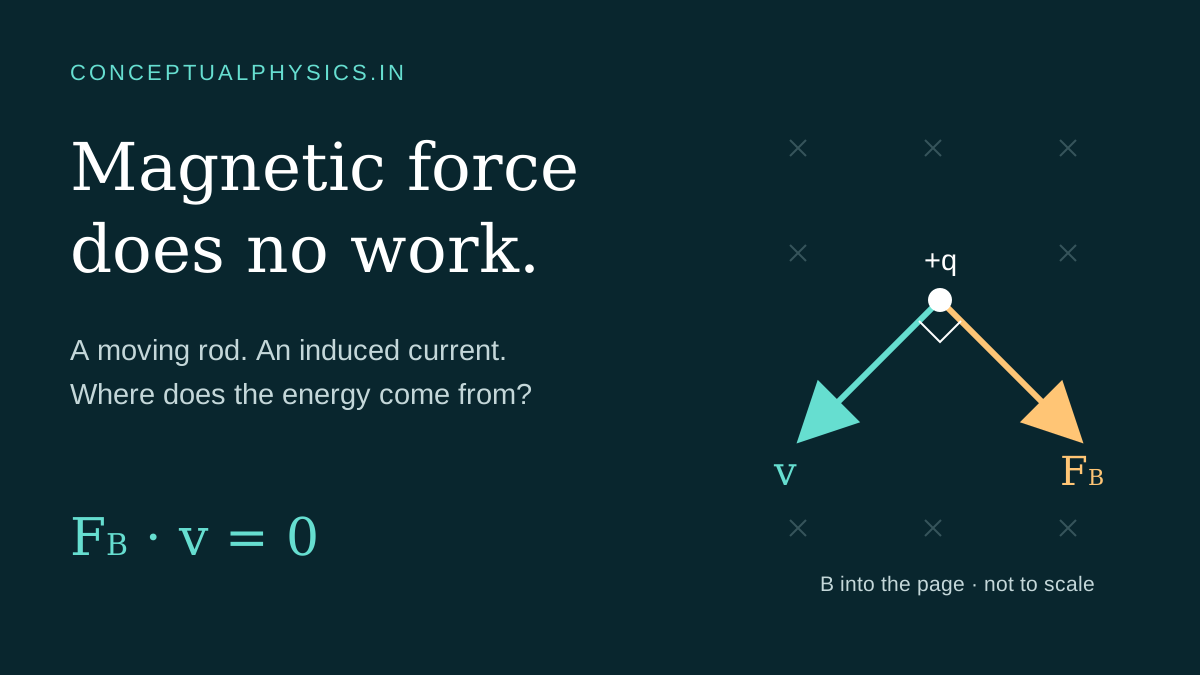
The total velocity of a representative positive charge has two components: leftward with the rod and downward relative to it. Their resultant points down-left. The magnetic force has a rightward component due to the drift and a downward component due to the rod’s motion. Its resultant points down-right, perpendicular to the total velocity.
The directions need not make 45-degree angles with the axes. Their angles depend on the relative magnitudes of and , but the force and the total velocity remain perpendicular. The magnetic force is not perpendicular to the drift velocity alone, which is why considering only that motion gives an apparent positive power.
Including the rod’s motion restores the complete description. The positive contribution is exactly cancelled by the negative contribution . There is no contradiction between the production of electrical energy and the zero work done by the magnetic force on each charge.
The central distinction is between motion relative to the rod and motion relative to the laboratory. Magnetic force can participate in converting mechanical energy into electrical energy while doing no net work on an individual charge. In this generator, the energy comes from the external agent pulling the rod, and the complete work calculation always uses the charge’s actual velocity in the chosen frame.