Look at the Sun and you see it as it was about eight minutes ago. Look at a distant star and you may see light that began its journey before you were born. A telescope does not give us an instantaneous view of the universe. It collects information that has taken time to reach us.
This is a direct consequence of the finite speed of light. In a vacuum, light travels at 299,792,458 metres per second. That is extremely fast on human scales, but astronomical distances are so large that the travel time becomes central to what we observe.
Distance becomes a record of time
For a source at rest relative to us in flat spacetime, the travel time is the distance divided by the speed of light.
A light-year is the distance light travels in one year. If a star is ten light-years away in this simple setting, the light arriving today was emitted ten years ago. The telescope is detecting an earlier event at the star, not its state at the same moment that we receive the light.
Across a photograph of the sky, different objects therefore represent different times. A nearby star and a faraway galaxy may appear next to each other in the image, although the light we receive from them began its journey in very different eras.
What changes when the universe expands?
Over cosmological distances, the simple division of a present-day distance by the speed of light is not generally enough. While light travels, the large-scale geometry of the universe evolves. Astronomers must specify what they mean by distance and use a model of cosmic expansion to relate distance, redshift, and travel time.
Cosmological expansion also stretches light. Light emitted with one wavelength can be received with a longer wavelength. This is called cosmological redshift. A large redshift generally indicates that we are observing an earlier stage of cosmic history, although converting the redshift into an age requires a cosmological model.
A spectrum contains more than a picture
A photograph tells us how light is distributed across the sky. A spectrum separates that light by wavelength. Atoms and molecules absorb or emit characteristic wavelengths, allowing astronomers to infer composition and physical conditions.
A spectral line is especially valuable because its laboratory wavelength gives us a reference. Comparing that reference with the observed wavelength helps reveal a redshift or blueshift. Temperature, motion, and the environment of the source can all leave measurable traces in the light.
Seeing the past does not mean seeing everything
Some regions are hidden by dust. Some objects are too faint to detect. Others emit mainly outside the visible range. Observing in radio, infrared, ultraviolet, X-rays, and gamma rays reveals different physical processes and different parts of an object.
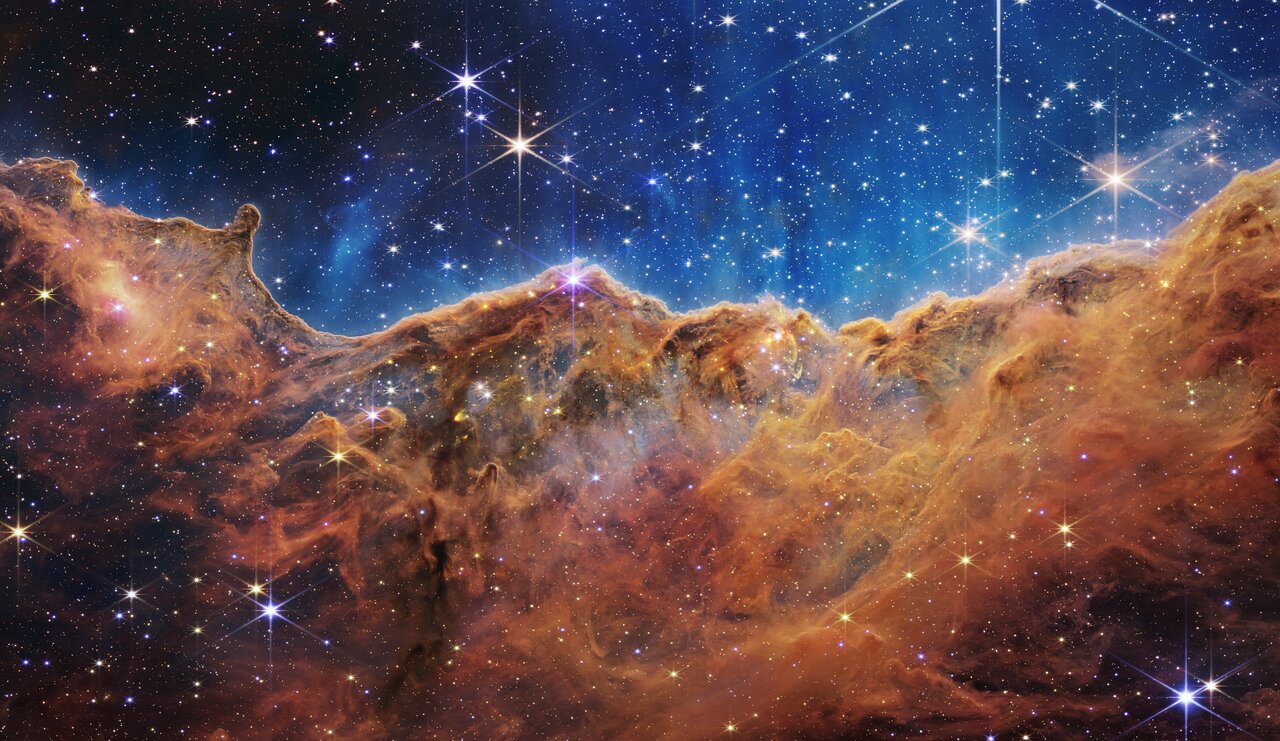
The Webb image above shows a star-forming region in our own galaxy. Its infrared observations reveal structures that are less accessible in visible light. The displayed colours map infrared measurements into colours our eyes can see; they are not a view through an ordinary optical eyepiece.
The essential idea is simple: an astronomical observation is a measurement of arriving information. By studying that information carefully, physics reconstructs the history and properties of the source.