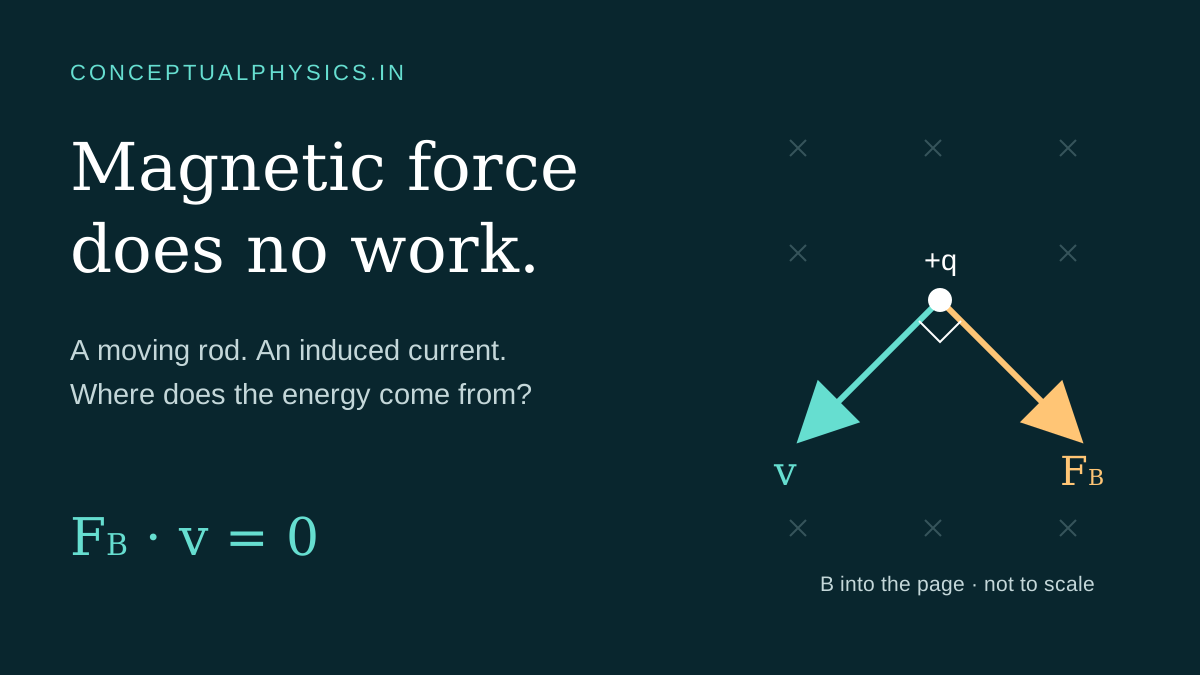
An electric field tells us the electric force per unit positive test charge at a location. A magnetic field helps determine the force on a moving charge. These definitions explain how a field affects matter, but fields also enter the accounting of energy and momentum.
If we charge a capacitor, work must be done to move additional charge against the growing electric potential difference. In the field description, energy is stored in the electric field between and around the conductors.
Energy is distributed in space
In vacuum, the energy density associated with electric and magnetic fields is
The quantities E and B are the magnitudes of the fields at the point being considered. The equation is local: it assigns an energy density to each location.
The direction and rate of electromagnetic energy flow are described by the Poynting vector. In vacuum, it is the vector product of the electric and magnetic fields divided by μ₀. Its magnitude gives power crossing unit area normal to the flow.
What travels in an electromagnetic wave?
In a plane electromagnetic wave in vacuum, the electric field, the magnetic field, and the direction of propagation are mutually perpendicular. The fields vary in time and space while energy and momentum are transported.
There is no need for a material substance to move along with the wave. This is one reason light can propagate through vacuum. Saying that energy travels does not imply that a hidden fluid is flowing through space.
A familiar example: sunlight
Sunlight carries energy from the Sun to Earth. Matter absorbs some of that radiation, and its internal energy can increase. The transferred momentum also produces radiation pressure, although in everyday conditions the effect is usually small.
The field picture links distant processes through local physical quantities: fields at each point, their evolution, and their interaction with matter. It turns the statement that light carries energy into equations that can be tested quantitatively.