Optical instruments such as microscopes, telescopes, cameras, and projectors are devices that form images of objects by making use of the phenomena of reflection and refraction of light. Depending on the nature of the final image produced, optical instruments may be broadly classified into two categories. In the first category, the instrument forms a real image that can be obtained on a screen, as in the case of cameras and projectors. In the second category, the instrument forms a virtual image that cannot be obtained on a screen and must be viewed directly by the human eye, as in microscopes and telescopes.
Principle of Visual Angle
The working of optical instruments designed for visual observation is based on the concept of the \emph{visual angle}. The apparent size of an object, as perceived by the eye, depends on the size of the image formed on the retina. This retinal image size is approximately proportional to the angle subtended by the object at the eye.
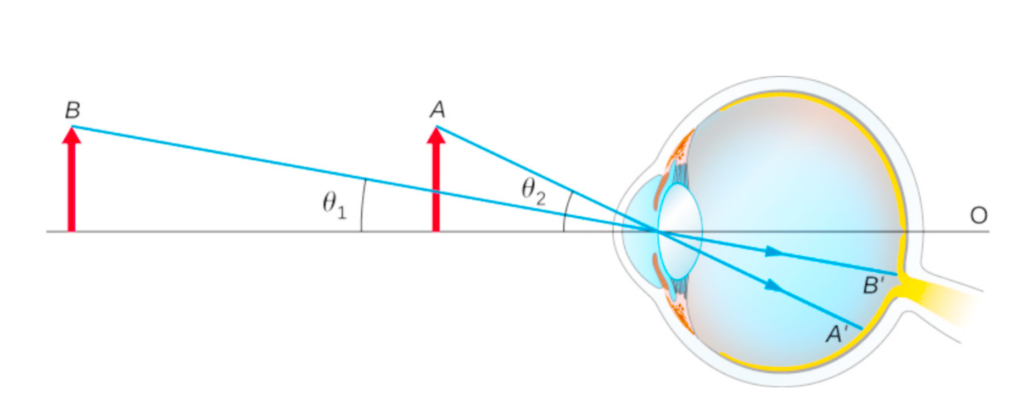
The human eye has a limitation in that it cannot focus clearly on objects placed closer than a certain minimum distance, known as the least distance of distinct vision, which is approximately $25\,\mathrm{cm}$ for a normal eye. Optical instruments overcome this limitation by forming images that either appear to be closer to the eye or subtend a larger angle at the eye. By artificially increasing the visual angle, these instruments enable the observer to perceive finer details and an apparently enlarged image of the object.
Image Formation in Compound Optical Instruments
Compound optical instruments, such as the compound microscope and the astronomical telescope, employ two converging lenses (or lens systems) arranged in succession.
The lens facing the object is called the \emph{objective}. Its function is to form a real and inverted image of the object. In a microscope, this image is magnified and formed close to the objective lens, whereas in a telescope, the image is formed at or near the focal plane of the objective.
The lens placed near the observer’s eye is called the \emph{eyepiece} or ocular. The real image formed by the objective acts as the object for the eyepiece. The eyepiece functions as a simple magnifying lens and produces a final image that is virtual, enlarged, and suitable for comfortable viewing. Depending on the adjustment, this final image may be formed at infinity or at the least distance of distinct vision.
Magnification in Optical Instruments
The enlargement produced by an optical instrument can be described in two distinct ways, depending on the nature of the image and the method of observation. These are linear magnification and angular magnification.
Linear (Lateral) Magnification
Linear magnification is defined as the ratio of the linear size (height) of the image to the linear size (height) of the object. If denotes the height of the image and denotes the height of the object, the linear magnification is given by
For images formed by lenses, this may also be expressed as
where is the image distance and is the object distance measured from the lens.
Linear magnification is primarily relevant for real images formed on a screen, such as those produced by cameras, projectors, or the objective lens of a microscope. The sign of m indicates the orientation of the image. For example, a value signifies that the image is inverted and twice the size of the object.
Angular Magnification (Magnifying Power)
Angular magnification, also known as magnifying power, is defined as the ratio of the angle subtended by the image at the eye when viewed through the instrument to the angle subtended by the object at the eye when viewed directly without the instrument.
If denotes the visual angle subtended by the image with the instrument and denotes the maximum visual angle subtended by the object for the unaided eye, the angular magnification is given by
Angular magnification is the appropriate measure of enlargement for optical instruments that form virtual images, such as microscopes and telescopes. In these instruments, the final image is not projected onto a screen but is viewed directly by the eye.
It is important to note that when an optical instrument forms its final image at infinity, the linear size of the image becomes theoretically infinite. In such cases, linear magnification loses its physical significance. However, the image still subtends a finite angle at the eye, and therefore angular magnification remains finite and meaningful. For this reason, angular magnification is the correct quantity to describe the performance of visual optical instruments.
Distinction Between Linear and Angular Magnification
Linear magnification compares the actual sizes of the image and object and is meaningful only for real images formed at finite distances. Angular magnification compares apparent sizes as perceived by the eye and is applicable to virtual images formed by visual aids. While linear magnification may become undefined for images at infinity, angular magnification continues to provide a correct measure of the apparent enlargement produced by the instrument.