In this post, we develop a structured, academic understanding of collisions. The emphasis is on clear definitions, physical interpretation, and conceptual clarity rather than on numerical problem-solving.
Types of Collisions: Geometry Matters
To simplify discussion, it is often helpful to imagine one body as a ball and the other as a fixed, smooth surface, such as a wall. The ball approaches the surface with some velocity and interacts with it over a very short interval of time.
Two directions play a crucial role in collision analysis:
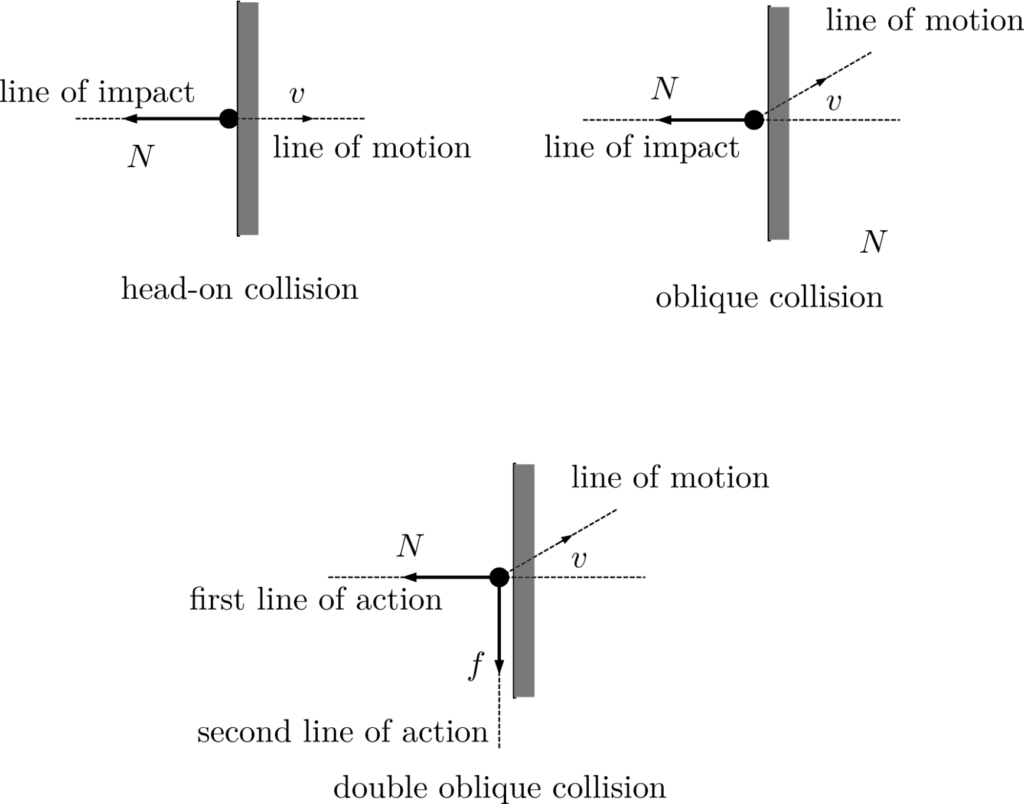
- Line of motion: the direction in which the body is moving just before the collision.
- Line of impact: the direction along which the impulsive (normal) force acts during the collision. For smooth surfaces, this is the normal to the surface at the point of contact.
Based on the relative orientation of these two directions, collisions are classified as follows.
Head-on Collision
If the line of motion of the incoming body coincides with the line of impact, the collision is called head-on (or direct). All changes in motion occur along a single straight line.
Oblique Collision
If the line of motion is not aligned with the line of impact, the collision is oblique. In this case, motion must be resolved into components normal and tangential to the surface.
Oblique–Double Collision
When friction is present at the point of contact, the interaction is more complex. Along with the normal impulsive force, a tangential impulsive force acts due to friction. This introduces two effective directions of impulse—normal and tangential—making the collision an oblique one with coupled effects.
The Coefficient of Restitution: Measuring “Bounciness”
During a collision, bodies deform and then attempt to recover their original shapes. Part of the mechanical energy is typically lost as heat, sound, or internal vibrations. The coefficient of restitution, denoted by e, quantifies how effectively a system recovers from deformation.
To define it, we focus only on motion along the line of impact.
- Velocity of approach: the relative velocity of the two bodies along the line of impact just before collision.
- Velocity of separation: the relative velocity along the same line just after collision.
The coefficient of restitution is defined as the ratio of the magnitude of the velocity of separation to that of the velocity of approach:
Its value lies in the range
for most ordinary collisions.
For perfectly inelastic (or perfectly plastic) collision, where bodies stick together.
For perfectly elastic collision, where no kinetic energy is lost.
For partially elastic collision.
Importantly, this definition applies only along the line of impact, not to tangential components of motion.
Conservation of Linear Momentum During Collision
Consider two bodies forming an isolated system during the very short time of collision. Each body experiences a large impulsive force due to the other, but these forces are equal in magnitude and opposite in direction, as required by Newton’s third law.
Because of this mutual cancellation of internal impulses, the total linear momentum of the system remains unchanged:
Even if external forces such as gravity act on the system, their impulses during the extremely short collision interval are usually negligible. As a result, momentum conservation holds to an excellent approximation during impact.
A key conceptual point is worth emphasizing:
- Internal impulses can significantly change the momenta of individual bodies.
- They cannot, however, change the total momentum of the system.
This distinction underlies nearly all collision analysis in mechanics.
Momentum and Kinetic Energy
Every moving body possesses both momentum and kinetic energy. While both depend on mass and velocity, they play different roles in collisions:
- Momentum is always conserved in an isolated system during collision.
- Kinetic energy may or may not be conserved.
This is why momentum conservation is the primary tool in collision analysis, while kinetic energy conservation is used only in special cases (such as perfectly elastic collisions).
Expressing kinetic energy in terms of momentum highlights this difference:
A small change in momentum can correspond to a large change in kinetic energy, and vice versa, depending on the situation.
Impact Between Two Bodies: Deformation and Restitution
An impact is a collision of very short duration in which large forces act between bodies. These forces may arise from direct contact, strong repulsive interactions, or constraints linking the bodies.
The collision process can be divided conceptually into two phases:
- Deformation period: the bodies press into each other, and deformation increases.
- Restitution period: the bodies attempt to recover their shapes and separate.
At the instant of maximum deformation, the relative velocity along the line of impact becomes zero. What happens afterward depends on the material properties of the bodies and is captured quantitatively by the coefficient of restitution.
Central and Eccentric Impact
Another important classification depends on the location of the mass centers relative to the line of impact.
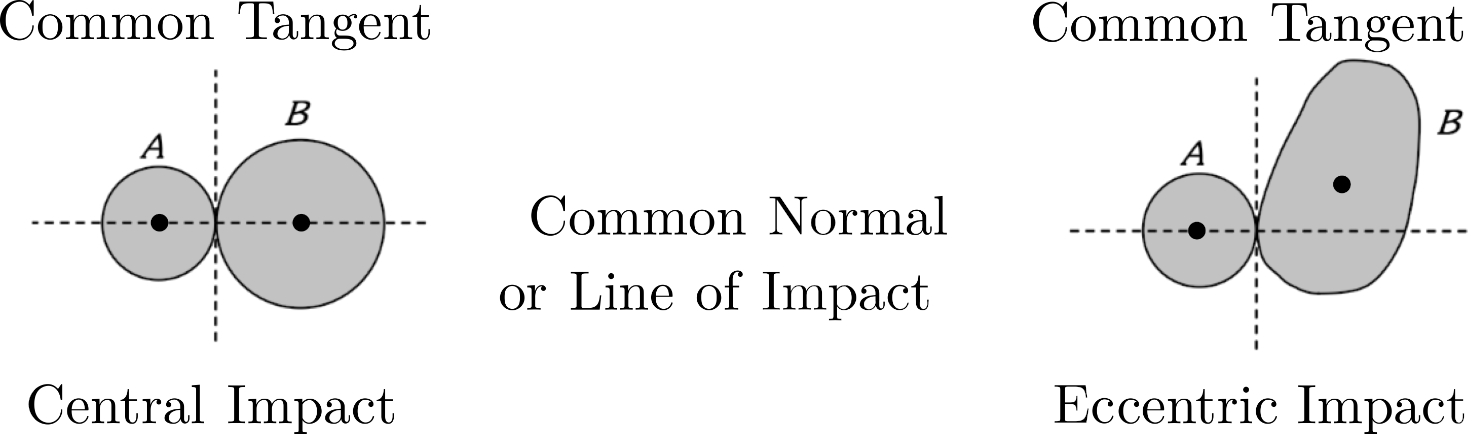
- Central impact: the mass centers of both bodies lie on the line of impact. Such collisions do not produce rotation.
- Eccentric impact: at least one mass center does not lie on the line of impact, leading to rotational motion after collision.
In introductory collision theory, attention is usually restricted to central impacts, with eccentric impacts treated later alongside rotational dynamics.
Head-on and Oblique Central Impact
For central impacts, classification is further refined based on velocity directions:
- Head-on (direct) central impact: velocities are along the line of impact.
- Oblique central impact: at least one velocity has a component perpendicular to the line of impact.
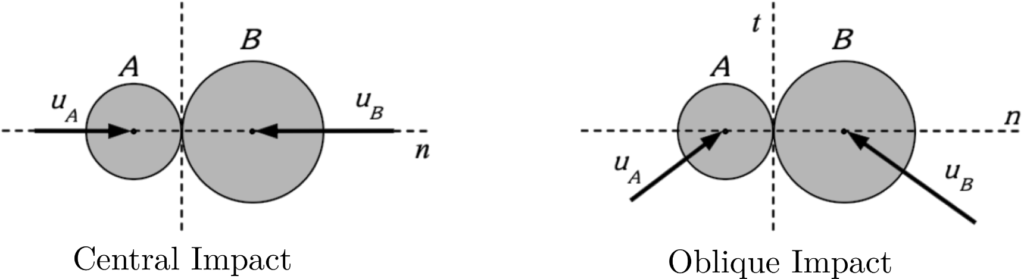
For analytical convenience, the line of impact is often called the normal axis (n-axis), and the perpendicular direction the tangential axis (t-axis).
Coefficient of Restitution Revisited: A Deeper View
From a more fundamental perspective, the coefficient of restitution can also be understood as the ratio of impulses during restitution and deformation. Because the contact force varies with time and differs in nature during these two phases, the impulses need not be equal.
This explains why energy is generally lost in collisions and why the value of e depends on material properties, surface conditions, temperature, and internal structure of the bodies involved.